Olive Ridley Turtle (Lepidochelys olivacea)
Size and Weight
- Carapace length: 50-75 cm, Weight- upto 45kg.
Status
Critically endangered
Life Span
- Average lifespan in the wild: 50 years
Description
- Olive ridleys get their name from the coloring of their heart-shaped shell, which starts out grey but becomes olive green once the turtles are adults. H.N. Ridley FRS first reported the sighting of Olive Ridleys in Brazil in 1887. They have one to two visible claws on each of their paddle-like flippers.
The olive ridley turtle is the smallest of the marine turtles.
- Male olive ridleys can be distinguished from females by their tails, which stick out beyond their carapace.
- They grow to an average of 70 cms long and adults weigh approximately 45 kgs.
Range
- Found in tropical regions of the Indian, Pacific and Atlantic Oceans, excluding the Caribbean. The largest nesting colonies occur in Mexico, Costa Rica and the Orissa coast, India
Habitat
- The olive ridley turtle inhabits tropical waters, and adults are known to be pelagic, feeding in the open ocean. Nesting tends to occur on mainland shores, on wide beaches that are often close to river or estuary mouths.
Biology

- Adult olive ridleys are mainly carnivorous and feed on a wide variety of organisms including jellyfish, snails, crabs, and shrimp, fish and molluscs.They will occasionally eat algae and seaweed as well. Very little is known about the first years of life but juveniles probably spend a number of years floating on the ocean currents and feeding on planktonic organisms.
- Olive ridleys have nesting sites all over the world, on tropical and subtropical beaches. During nesting, they use the wind and the tide to help them reach the beach. Females lay about 100 eggs, but may nest up to three times a year. The nesting season is from June to December.
- Although they do also nest alone, olive ridleys are known for their remarkable mass nestings, when many thousands of females congregate on the same beach where they hatched;the event is known as an arribada, which is Spanish for mass arrival.
- Males and females migrate from the feeding grounds and mating occurs just offshore of the beach. Usually at night, and coinciding their nesting with the high tide, females haul out on their natal beach and lay clutches that typically contain around 110 to 120 eggs. These astonishing mass nestings can involve up to 150,000 females and there may be more than one arribada on a single beach; this overcrowding means that turtles are often crawling over each other to move up the beach and may even unearth other nests whilst digging their own.
- During one season a female may lay two to three clutches of eggs, returning to breed every few years. After around 50 to 60 days, the hatchlings emerge and make their journey to the sea.
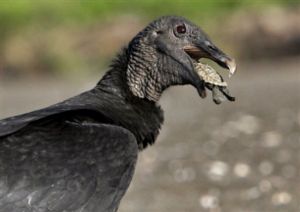
- Predators such as jackals and crabs will feed on turtle eggs, whilst birds attack hatchlings on the beach and fish wait in the shallows. These arribadas probably function to increase hatchling survival by overwhelming predators with sheer numbers.The turtle's strategy of laying a lot of eggs, which hatch at the same time, works well against predators like seabirds and monitor lizards, who can only eat one or two at a time, and can't take a few more home to keep.
Role
Sea turtles play key roles in two ecosystems that are critical to them as well as to humans—the oceans and beaches/dunes.
Threats
- Nesting in such large congregations, the olive ridley turtle is particularly vulnerable to human activities such as development and exploitation. This turtle has been extensively over-harvested for its eggs and meat.
- In Central and South America there is a massive market for the now illegal turtle eggs, which are traditionally believed to have aphrodisiac properties.
- One of the most important threats to the olive ridley is incidental catch (bycatch) by the fishing industry; turtles caught in trawl nets drown (accidental death)and are then discarded. The turtles, as air-breathing reptiles, must surface to breathe. Caught in a fisherman's net, they are unable to go to the surface to breathe and suffocate to death in the net. Between 1993 and 1999, more than 50,000 dead turtles were found along the Orissa coast in India, primarily as a direct result of illegal fishing in the area.
- Marine debris, especially from abandoned fishing nets in which they can become entangled.
News Related to Olive Ridley Turtles
- March 2010..... Good news for all Olive ridley turtle lovers!!!!!!!!!!!!!!!!!
The mass nesting of Olive Ridley turtles commenced on 14th March at Rushikulaya in Orissa. Annually, this happens in mid February before mass nesting further north at Gahirmatha. This year the turtles lived up to their reputation of being unpredictable. The congregation at Rushikulaya was very close to the beach by the third week of February, but receded suddenly. The mass nesting occurred thereafter at Gahirmatha. Approximately one lakh and eighty six thousand (according to Forest Department figures) female turtles nested at Gahirmatha.
WWF-India(World Wide Fund For Nature-India) team along with Government of India Forest department ,Orissa which played a critical role in the mass nesting phenomenon.
- In early 2007, almost a thousand sea turtles were killed inadvertently in the Bay of Bengal over the course of a few months as a result of becoming trapped in fishing nets.
- In Aug 2007,nearly 57,000 Olive Ridley turtle eggs were recovered from smugglers, near the Oaxacan beach in southern Mexican state of Oaxaca.
Conservation
- International trade in olive ridley turtles and products is banned under their listing on Appendix I of the Convention on International Trade in Endangered Species (CITES) but a significant illegal trade (particularly in eggs) still occurs. *TRAFFIC (the wildlife trade monitoring arm of WWF and the IUCN) is involved in monitoring black market trade and bringing it to the attention of relevant authorities.
- The fitting of Turtle Excluding Devices (TEDs) to shrimp-trawl nets offers an encouraging step in their conservation; a 'trap-door' in the net allows the large turtles to escape. Their use is still not widespread however, and even in countries where the use of TED's is mandatory, this is not enforced.
- A number of major nesting beaches are protected and conservation projects work to artificially rear turtle eggs and then release them. Recently the number of olive ridleys nesting in Mexico has increased, and arribadas have returned to the Gahirmatha rookery in Orissa, India; perhaps offering a glimmer of hope that conservation efforts are working.
--Yanubha 11:56, 2 April 2009 (UTC)
|


