Copyright teaser
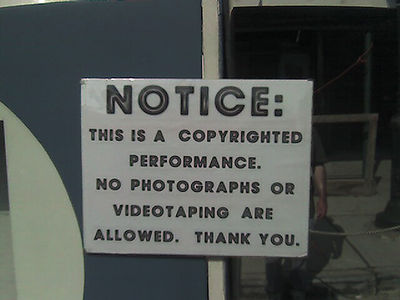
Off to see a live performance of Shakespeare
You're off to see a production of Shakespeare and see the following photo at the entrance of the theatre. Consider the following questions:
- Must creative works be fixed in a tangible form (eg print, CD or DVD recording) before it can be protected by copyright? (In this example the works of Shakespeare are in the public domain and the public performance is not in a fixed form.)
- Yes
- It depends. Many countries require that a work must be fixed before it can enjoy copyright protection, while countries with a civil law tradition may not have this requirement. Check national legislation which may provide protections for performers and broadcasts.
- No
- If national legislation does not have a requirement for the work to be fixed, copyright protection will take place from the momment the performance is given. Note that national legislation may provide protections for performers and broadcasters as related rights.
- Can you take a photograph of a copyrighted work?
- Yes
- Incorrect. Photographing a copyright work amounts to reproducing it and as a general rule is not permitted. There are exceptions, for example taking a photograph of a sculpture exhibited in a public place in some countries. You can find more detail on photographs and exceptions on the World Intellectual Property Organisation (WIPO) exceptions and practices site.
- No
- Correct. Generally speaking, a photograph is a copy and copying is one of the protections provided by copyright. If the object being photographed is protected by copyright (or other intellectual property rights like trademarks), you may not take a photograph of a protected work. However, there are some exceptions and practices which may be permitted.
- Can you copyright an idea, for example, the formula for calculating the area of a triangle in a maths textbook?
[math]\mathrm{Area}=\frac{1}{2}bh[/math]
- Yes
- Incorrect. Generally speaking, you cannot copyright an idea. It is the layout and format (expression of the idea) which is copyrighted and usually there is a requirement of originality for copyright to apply.
- No
- Correct. It is the expression of an idea which is copyrighted taking into account the requirement for originality.
The copyright teaser illustrates two important issues:
- There are certain requirements for a work to qualify for copyright protection; and
- It is important to obtain a copy of your own national copyright legislation to know what conditions apply on your country.
When does a work qualify for copyright protection?
Key points
- Copyright is used to protect creative works
- Very often, copyright requires an expression in a particular form
- The form and style of the expression is protected, not the underlying idea.
- There is usually a condition of originality
|

|


