Acharya Narendra Dev College

Welcome to the Acharya Narendra Dev College page
Building capacity for open education together
Contents
- 1 College organized three days conference OPEN 2011 on Open Paradigms in Education from 31 January to 2 February 2011 at India International Centre
- 2 College organized two days symposium on Chemistry in Biology: The Future of Life Sciences on February 12, 13 2010 at India International Centre
- 3 Ruchika Pokhriyal wins Ist Prize in Essay Competition - goes for the UN Climate meet at Copenhagen
- 4 eContent Development through Easynow - Some Exemplars
- 5 LEARNING PHYSICS THROUGH PROBLEM SOLVING
- 6 CONGRATULATIONS - THREE TEACHERS FROM ANDC AWARDED ON TEACHERS DAY Dr. Sarita Kumar, Dr. M.S. Rajeswari, Dr. Seema Makhija
- 7 ANDC in the News
- 8 Linux Cluster Project in the College
- 9 Linux '09 - Workshop on Linux, FOSS and Clustering
- 10 L4C Workshops on Open Educational Resources
- 11 L4C68 Workshop
- 12 Easynow Workshop
- 13 Protocols for Experiments in the area of Biology for B.Sc Programme
- 14 CPURT Resources
- 15 Workshops in the College
- 16 Investigative Projects
- 17 Links to some pages associated with the college Principal, Dr. Savithri Singh:
- 18 Wikieducators at AND college
- 19 Department Of Chemistry
- 20 Department Of Physics's Wiki page
- 21 Department Of Zoology at ANDC
- 22 Foreign Language Centre
- 23 Chemistry Classroom Assignments
- 24 WikiEd09
- 25 Wiki Projects
College organized three days conference OPEN 2011 on Open Paradigms in Education from 31 January to 2 February 2011 at India International Centre
The college organized an International conference OPEN 2011 on Open Paradigms in Education from 31 January to 2 February 2011 at India International Centre, Lodhi Estate, New Delhi. It was an attempt to blend open source soft skills with knowledge modules. The conference was primarily focused on OER (Open Educational Resources), FOSS (Free and Open Software) tools, Licensing on educational material, Copyright/Copyleft, creative commons, etc. This endeavour helped to expose the educators to the importance of open access to learning opportunities by sharing knowledge and learning resources.
For details, please click OPEN 2011
==College organized two days symposium on Chemistry in Biology: The Future of Life Sciences on February 12, 13 2010 at India International Centre
In present scenario, Biology and Chemistry have become intertwined disciplines. To understand any biological phenomenon it’s imperative to know the chemical molecules and the reactions involved. Further chemistry may provide the basis of understanding of many unexplained biological phenomena in near future too. Keeping this in view it becomes important that the young undergraduate students, who are our future researchers, understand the biology and chemistry as integrated subjects though they are taught these subjects as distinct disciplines. This can be achieved through fruitful interactions with renowned people in this field.
With this aim in mind, Acharya Narendra Dev College organized a two day National Symposium on ‘Chemistry in Biology: The Future of Life Sciences’ on 12th and13th February, 2010. The talks at the symposium focused on the application of chemistry for addressing questions related to biological and biomedical sciences. The symposium featured interesting scientific deliberations and interactive sessions by eminent scientists of international repute in various fields like Nano-medicine, Computer- Assisted Drug Design, Green Chemistry and Clean Technology. The primary objective of the symposium was to provide exposure and opportunities to teachers as well as the students of undergraduate/ postgraduate colleges of various universities to interact with and learn from some of the best researchers in the field and to give a comprehensive overview of these multifaceted disciplines. At the symposium, students also got an opportunity to showcase their talent through oral as well as poster presentations.
Ms. Radhika Warikoo, Project Associate under Dr. Sarita Kumar was honoured with young chemical biologist award for best oral presentation.
Three teams were selected for best poster award. These are:
1. Sakshi Gera, Taruna Arora, and Rajesh Chaudhary,B. Sc. (H) Biomedical Sciences
2. Kartika Vashishtha, Kirti Gupta and Ruchika Pokhriyal, B. Sc. (H) Biomedical Sciences
3. Vikas Sachdeva, Nitin Kumar, Abhay Pratap Singh, B. Sc. (H) Zoology
Session-wise report is as under:
Session I: Structural Biology and Drug Discovery
Poster presentation by Students
Session II: Nano-Medicine and Nano-Devices
Session III: Green Chemistry
Oral Presentations by students
Session IV: Panel Discussion on Teaching Science
==Ruchika Pokhriyal wins Ist Prize in Essay Competition - goes for the UN Climate meet at Copenhagen
 Minister of State for Environment and Forests, Jairam Ramesh along with the youth delegation which will be part of Indian delegation for COP-15 The UN framework convention on climate change at Copenhagen. (from left) Deeksha Singh, Ruchika Pokhriyal, Aadya Dube and Ramsha Sajid in New Delhi on November 4, 2009.
Our student Ruchika Pokhriyal of Bio Medical Sciences was selected to represent the Indian Youth at the COP 15 - The United Nations Convention on Climate Change' inCopenhagen, Denmark from December 7 - 18, 2009. This is because she won the 'First Prize ' in the Senior Section of the Prithvi Ratna National Essay Writing Competition for Youth on Climate Change conducted by the Ministry of Environment and Forests and the WWF (World Wide Fund for Nature)-India. (http://www.wwfindia.org/)
The competition was held for two groups - ages 16-18 and 19-21. Competitors were asked to write an essay on ' You are India's future generation - How can you lead/influence the climate change challenge to ensure a sustainable future for the country and the planet?' Ruchika won the first prize in the senior category.
HEARTIEST CONGRATULATIONS TO HER!!
SOME LINKS TO THE PRESS RELEASES
I am indeed proud to share this information with you !
Also, the 'First' and 'Third' prize was won by our students Swati Jha and Priya (Chemistry Hons. III yr) at the Inter-College Paper Chemistry Presentation Competition held at St Stephen's College by their Chemistry Society. Both of them presented the projects they did in college during the summer vacations. They will also present their papers at the CHEMISTRY MEET 2009 that is sponsored by the Royal Society of Chemistry, London.
CONGRATULATIONS TO ALL OF THEM!!!
==eContent Development through Easynow - Some Exemplars
About
We, at Acharya Narendra Dev College believe that access to educational content should not be a limitation for those who want to learn. Towards that end we strongly support development of Open Educational Resources or OER. We have been using the Wikieducator as the space on the world wide web for the OER developed by teachers of the college. We have conducted several Learning for Content or L4C workshops in 2008-09 with support of the Commonwealth of Learning, Vancouver, to encourage educationists to learn how to ‘wiki’ and upload educational content. As strong supporters of ‘Open source’ we believe in the use of ‘creative commons’ licence for the materials.
Globally most educational systems have accepted the enriching impact of the wide range of IC technologies and wish to integrate them at all levels of educational administration. This integration of ICT is cost-intensive, unable to garner sufficient resources and it becomes prohibitive in many cases. Also, the academics interested in creation of courseware may have paucity of knowledge on IC techniques. Self-training is a possibility, but it is a stupendous task even for the most computer-savvy; considering the fact that one has to research several packages before one can choose the most suitable one for his needs, deal with the poor network facilities and bear the costs involved. Most likely contributors will have/like to be trained in understanding and using a set of pre-selected tools that have been chosen for their suitability for educational purpose, ease of use and the costs involved. We believe that it should be easy for teachers to upload content and other learning resources n the web – lack of knowledge of technology should not be a deterrent to uploading of educational materials.
EasyNow is a select set of easily available mostly open source ICT tools that can be easily learned and utilised by the content developers to produce quality materials suitable for Open and Distance Learning on the World Wide Web. It integrates use of multiple media like text, audio and video tools that allows for inexpensive production and quick upload by the developers. These tools have been collated by Mr. V. Krishnamoorthy, a Consultant Commonwealth Educational and Media centre for Asia (CEMCA).
Teachers use vast and rich resources for their own classroom teaching, but this material is lost to others. This is of particular significance when we consider the huge pool of very senior and may be retired teachers who have vast experience but have no means to share what they have learnt beyond their immediate circle. It would be very empowering if teachers can be taught how to:
- adapt materials to distance learning,
- enrich content with audio, video add-ons,
- supplement the contents with quizzes, question banks,
- incorporate self assessment tools,
- collate the materials to make a package, and
- prepare it for distribution, etc.
This is exactly what EasyNow aims to do – teach these easily-learnt skills to content writers in such a way that they form a huge pool of human resources to contribute and meet the large demand of e-learning and web based learning materials
The aim of EasyNow is to help in easy and cost-effective production of quality materials in multiple formats that can be disseminated using CD’s to far flung areas where the chief problem is the availability of good educational opportunities. These areas may lack good quality of teaching unless teachers have access to the vast expanding knowledge base. Thus. the availability of well-made and easy to use IC integrated multiple media materials created using EasyNow can play a major role in these areas.
eContent
A Base Camp was recently held in the college (September -October 2009) wherein 17 teachers both from our college and other colleges of the University were trained in content development. eContent has been developed on some topics in Biology, Chemistry, Physics, Mathematics and Computer Science. The content so developed has been uploaded at the Eduframe site. We'll be happy to receive feed back on these content at by email to the Easynow group at ANDC
LEARNING PHYSICS THROUGH PROBLEM SOLVING
Learning Physics site aims at promotion of teaching-learning of physics by solving problems using thinking and reasoning. The effort is to demonstrate the power of physics concepts in understanding nature and expose excitement of learning physics.
In addition to building a programme for learning physics around solutions of some suitably selected problems given as mathematical texts supported with graphics, animations and multimedia, we will encourage interactive learning through 'talk pages' and discussion.
The problems have been selected mainly from the books 'Physics' by Resnick, Halliday, and Krane, and 'Fundamentals of Physics' by Halliday, Resnick and Walker. Some interesting problems from other textbooks such as 'Heat and Thermodynamics' by Zemansky have been included. The solutions have been provided by Prof. A.N. Maheshwari who finds solving physics problems intellectually stimulating and an enjoyable activity. He is happy to share his experience of teaching-learning of physics with fellow teachers & students. He is happy to donate all the materials created by him as an Open Educational Resource.
We take pleasure in inviting physics teachers and students by writing in to Learning Physics Group at ANDC to give to us your valuable comments and with your support we hope to make this site a purposeful learning physics resource. The problems have been classified under :
==CONGRATULATIONS - THREE TEACHERS FROM ANDC AWARDED ON TEACHERS DAY
Dr. Sarita Kumar, Dr. M.S. Rajeswari, Dr. Seema Makhija


ANDC in the News
- Research in the College
- Delhi College to promote Research
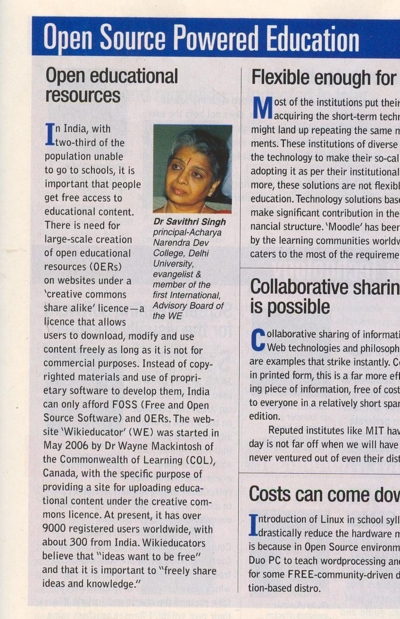
- Launch of India Chapter of Wikieducator
- Brief report of a talk published in Electronics for You July 2009 issue
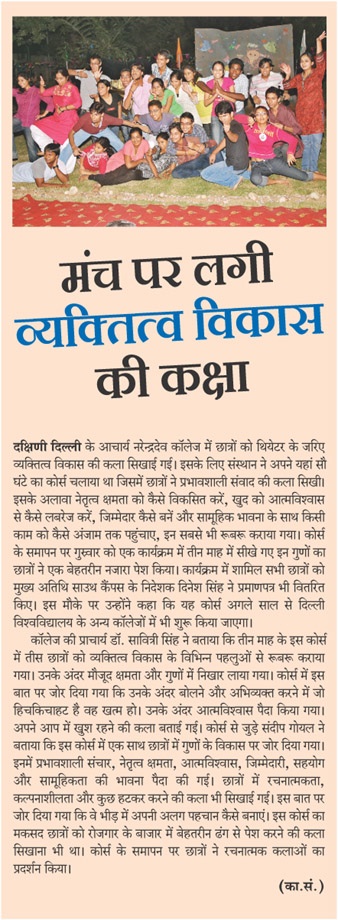
- Report of the Culmination function of the 'Effective Communication and Personality Development through Theatre' Add-on Course, October 8, 2009
==


Linux Cluster Project in the College
The college has as a matter of principle shifted to Open Source and Linux in most of the over two hundred computers in the college. We also thought it would be useful if students could understand and appreciate how groups of computers could be made to work together in clusters - that do parallel or sequential processing and increase efficiency. Towards that end a Linux Cluster Laboratory was set up in the college wherein old computers that are of no use to the college were shifted. A small group of one teacher and 4 students (now there are three) of computer science started working on the in January 2008. The University of Delhi was very supportive and enthusiastic about these experiments with clustering. The 'Cluster Laboratory' also got some financial support from the University.
The cluster team is writing up their project for presentation at a conference and the draft is available at Linux Cluster Laboratory.
The ANDC cluster team presented their work at the Linux'09 Workshop. Please see the presentations by clicking:
Linux '09 - Workshop on Linux, FOSS and Clustering
The college organised a five -day (two days for 20 advance learners) from 3 Jan to 7 Jan 09. The workshop that had a total of 90 participants (&0 students and 20 teachers) had Amit Karpe and Dyanray Mali from Pune as resoure persons. It was also marked by lectures by Niyam Bhushan - the Foss evangelist and Graphics expert. What was also significant and something we are proud of - several students gave talks on various issue/aspects. The Linux cluster group did us proud during their half-day session on Clustering - they dealt with all the hardware and software issues related to clustering.

The jubilant Core team of the Linux '09 Workshop after the last session.
The workshop was marked by several presentations made by students For presentations made by students click the link against their names:
- Animesh Kumar and Ankit
- Sudhang Shankar
- Abhishek Nandkumar
- Ajaz Ahmed and Reyaz Ahmed
- Vedant
- Priyanka
For some more photographs of the event please click photos and to read blogs of a Linux enthusiasts in the college click here,here and here
L4C Workshops on Open Educational Resources
L4C68 Workshop
The college in association with CEMCA is organizing three days workshop In TMM University, Moradabad from 3-5 September, 2010.
L4C workshops-L4C-42& L4C-43
The college is organizing two parallel L4C workshops, L4C-42 and L4C-43 from 13th-17th April 2009. These workshops are being organized in association with University of Delhi South Campus and are supported by Commonwealth of Learning Vancouver. The venue of these workshops is Room No. 115, University of Delhi, South Campus. These workshops aim to introduce participants to OER, FOSS and Wiki Educator. For details like list of participants etc click OER -1 or OER - 2

WikiEd09 workshops

The college organised two L4C wokshops from 9 January - 13 January in the Web Facilitation Centre of the College. Details are available at Wikied09
==Easynow Workshop
The college held one and a half day Easynow workshop in the college with support from CEMCA. This was basically as effort to understand the various tools available for preparation of multimedia and for compression of photos, audios, videoa etc. Dr Krishnamoorthy was the resource person. For photographs of the workshop please see this page. it is obvious that we need to look for open source software that can be used to get similar results.
Protocols for Experiments in the area of Biology for B.Sc Programme
There was a recent change in undergraduate syllabi in the University of Delhi resulting in several new exciting experiments being added. We've decided to wrtieup the protocols and upload them for access to students and teachers through the University and beyond.
CPURT Resources
The Acharya Narendra Dev College (University of Delhi ) has set up a virtual 'Centre for Promoting Undergraduate Research and Training'. This Centre conducts hands-on training workshps for students and faculty of various colleges in the University in the core areas of science. We are at present developing hand-outs for the training courses which we intend uploading on the WE. These materials will be used for training school teachers also.
Workshops in the College
Some of the training programmes that were conducted recently:
- Electrawork ’06 - PC hardware, PC assembling and programming of VHDL.
- Electrawork ’08 - Data Acquisition using LabVIEW and PC design and fabrication
- FOSS and Linux Workshop (three)
- Understanding complexities of life from molecules to system: Concepts and tools - summer Workshop.
- Basic Techniques in Molecular Biology - One month summer training.
- Chemistry Workshop
Investigative Projects
The CPURT Centre will encourage the undergraduate students to undertake small investigative projects based on the hands-on training. This ia an illustrative list of projects already conducted by the students.
- Deposition of thin films of electrode materials including Aluminium, Gold and Silver using Thermal Evaporation.
- Deposition of thin film oxide materials using Sol-gel method.
- Development of interdigital electrodes of Aluminium using photolithography.
- Study of optical transmittance of thin films using UV-Vis spectrophotometer.
- Study of resistance variation in metal-oxide thin film hetero-structures (SnO2, ZnO) as a function of temperature and surrounding environment.
- Measurement of UV photo-response of ZnO thin films using Tektronix oscilloscope interfaced with a computer.
- Preparation of nanoparticles (Co, Cu, Au) using the chemical route (reverse-micellar method etc.).
- Use of Pulsed LASER Deposition (PLD) technique for deposition of multi-component thin films.
- Estimating PN diode bulk parameters, bandgap energy at absolute zero.
- Analysis of light emission processes in LED and semiconductor lasers.
- Determination of electric power in AC circuit.
- Verification of relation between the bandgap energy and energy of photon emitted by LED.
- Preparation of polymers
- Synthesis and characterization of polymer-clay composites.
- To study the effect of hydroxide ions on hexaaqua metal ions(III) and effect on reversing the process: Hydrolysis and aquation of hexaaqua metal ions(III) using pH meter and conductivity meter
- Effect on pH and colour change on dilution of aqua complexes of tripositive ions of Iron, Cobalt and Aluminium : Role of water as base and as ligand using pH meter
- To study the ligand exchange reactions of hexaaqua complexes of cobalt (III)
- Exchange of water molecules with NH3, OH-, Cl-, EDTA and CO32-
- Study of kinetics of KI and K2S2O8 colorimetrically and compare with results got volumetrically
- To study basicity of commercial antacids volumetrically
- To study acidity of commercial fruit juices volumetrically
- Estimation of Cu in Cu alloys iodometrically
- Determination of hardness of soil complexometrically
- Analysis of cement samples for Mg and Ca complexometrically
- To study the best solvent system for qualitative analysis of metal ions
- To study conductance of different electrolytes with concentration
- To study conductance of strong electrolytes at infinite dilution
- To determine molar conductivity of weak electrolytes and study KOHLRAUSCH law and write a computer programme for its calculations
- To study phase diagrams using capillary tube methods : A green experiment using very small quantities
- Ecology project on effect of painted idols on aquatic fauna (Animal studied Branchionos)
- Paper Recycling (This project won a Rs 25,000/- prize at the inter-college eco-club competition carried out by the Government of NCT).
- To study the planktonic diversity in selected high altitude lakes i.e. Dal Lake of Dharamshala, lake of Khajjiar, oxbow lake of Rockgarden.
- Ecology project on relative abundance of endangered animals in National Zoological parks.
- Distribution of plants and trees in the college campus.
- Monitoring of meso- and macro-benthic invertebrates at polluted and unpolluted sites of river Yamuna in order to develop a model system for bio-indication of pollution.
- Zooplankton egg bank diversity of two lakes in Delhi(lake Bhalaswa and Tajpur Pahadi lake) – A comparative field and experimental investigation.
- Differential behaviour shown by a castrated male dog.
- To study and compare morphology and ecology of Prosopis ineraria and Prosopis juliflora with a brief note on their ecological role.
- To study Xerosere: Study various stages of ecological succession on bare rocks.
- To study effect of Gibberellins on the germination, growth and development of different seeds of different plants.
- Wild flora of Acharya Narendra Dev College.
- To analyze dust accumulation on leaf surfaces of different plants in Acharya Narendra Dev College campus.
- To study the number of apomictic embryos in citrus seeds.
Links to some pages associated with the college Principal, Dr. Savithri Singh:
Acharya Narendra Dev College on wikipedia
Wikieducator Election Campaign Page
Savithri Singh's Page
Bamboo and Rattan Course Proposal
Rattan Course
PCF5 Paper
Workshop on Open Educational Resources
For some Photographs click here and here. On Wikied'09
Wikieducators at AND college
Department Of Chemistry
- Department of Chemistry at ANDC is one of the largest Departments in the college. For details Click here
Department Of Physics's Wiki page
Department Of Zoology at ANDC
For details please click here
Foreign Language Centre
For details please click here
Chemistry Classroom Assignments
The teachers of the department of chemistry have started uploading their assignments and study material on the wikieducator pages. This project is in the starting stage. To go through the assignments please click here. For B.Sc. Programme click B.Sc. Programme
==WikiEd09
For Latex tutorials click here. The page title is LATEX Tutorials
==Wiki Projects
Dr. Sarita Kumar has initiated the following projects:
a) Project on the glossary of entomolgical terms.... For details and contibutins, please click Entomology Terminology.
b) Project on the Museology in context with Zoology.....For details and contributions, please click Zoology Museum

|
Work in progress, expect frequent changes. Help and feedback is welcome. See discussion page. |
|

